

Docs Show New Anti-Enviro Laws Copy Pasted From Big Polluter Wish Lists – Greens

Documents obtained by the Green Party have revealed how key sections of new anti-environment laws to be passed this week replicate powerful, polluting industry demands.
The Natural Environment Bill and Planning Bill will go to their third readings this week. These are the laws replacing New Zealand’s foundational environmental law, the Resource Management Act (RMA).
Changes to the bills that appear to have come straight from industry lobby groups include critical wording on climate impacts, pollution limits, resource use limits, and environmental health, while including special provisions for specific industries, and reducing public input opportunities. This occurred despite repeated official advice, and independent expert warnings.
“Let there be no mistake. This government has gutted critical environmental safeguards as dictated by powerful, polluting lobbyists who will make huge profits as a result,” Green Party Co-leader Marama Davidson says.
“This week, Luxon’s Government will grant a polluter’s wish list, embedding climate denial and an open invitation to destroy nature into law. Critical protections at the heart of our planning and environmental laws will be deleted or replaced according to industry wish lists.”
“These documents show that while the public, NGOs and independent experts were largely limited to ordinary select committee processes – and ignored, agri-businesses were being hosted in a closed door ‘workshop’ by Minister Chris Bishop, Under-Secretary Simon Court, and Minister Todd McClay.
“In this parallel meeting, agri-lobby groups went as far as to question “whether protecting ‘life-supporting capacity’ sets too high a bar… when determining a limit”. This is how extreme these industries are – that life itself is deemed inconvenient. Government Ministers must be held accountable for whose interests they are serving.” Marama says.
Fonterra, one of the lobby groups present, was recently revealed as being behind secret communications with the Prime Minister’s office, ahead of a law change stripping New Zealanders of their right to take big climate polluters to court.
Changes made to the draft legislation, reviewed alongside OIA documents and industry submissions, show the agricultural and horticultural industries have:
- successfully lobbied to remove from the ‘goals’ of the Bill that the use and development of natural resources occur “within environmental limits”
- successfully lobbied to insert an industry-specific enabling clause to the goals of the Bill, so that it “enable[s] the use and development of natural resources, including for the production of food and fibre (including aquaculture)”
- successfully lobbied to remove the precautionary principle from explicit consideration in decision-making
- successfully lobbied to add a clause preventing decision-makers from considering the negative impacts of greenhouse gas emissions in causing climate change
- successfully lobbied to “ensure activities can be consented even if a [environmental] limit is breached”
- raised concerns “about whether protecting ‘life-supporting capacity’ sets too high a bar…” in environmental law
- successfully lobbied to require narrow cost-benefit analyses to be undertaken when setting ecosystem health limits, which officials warned “cannot fully account for” positive environmental outcomes “such as clean water for swimming or flood attenuation from green infrastructure such as wetlands…”.
- successfully lobbied to limit public engagement on ‘Action Plans’ (leaving discretion with the Minister), which could control how industry must respond to environmental pollution
- successfully lobbied for the deletion of all references to “caps on resource use”
- successfully lobbied for changes to the freshwater farm plan system
- blocked regional councils from protecting the inshore marine environment from destructive fishing activity
“Aotearoa has one chance, on November the 7th, to stop these dystopian laws from becoming reality. Now is the time to believe in a better way, to enrol by October the 25th, and then vote this government out.” says Davidson.
Notes:
There has been substantial lobbying (and success) from the agricultural, horticultural, and fishing industry on environmental law reform during this term of Government. Regarding the Natural Environment Bill—part of the replacement for the Resource Management Act—the sectors have (among other things):
- successfully lobbied to remove from the ‘goals’ of the Bill that the use and development of natural resources occur “within environmental limits”
- successfully lobbied to insert an industry-specific enabling clause to the goals of the Bill, so that it “enable[s] the use and development of natural resources, including for the production of food and fibre (including aquaculture)”
- successfully lobbied to remove the precautionary principle from explicit consideration in decision-making
- successfully lobbied to add a clause preventing decision-makers from considering the negative impacts of greenhouse gas emissions in causing climate change
- successfully lobbied to “ensure activities can be consented even if a [environmental] limit is breached”
- raised concerns “about whether protecting ‘life-supporting capacity’ sets too high a bar…” in environmental law
- successfully lobbied to require cost-benefit analyses to be undertaken when setting ecosystem health limits
- successfully lobbied to limit public engagement on ‘Action Plans’ (leaving discretion with the Minister), which could control how industry must respond to environmental pollution
- successfully lobbied for the deletion of all references to “caps on resource use”
- successfully lobbied for changes to the freshwater farm plan system
- Blocked regional councils from protecting the inshore marine environment from destructive fishing activity
Details of each of the above lobbying cases are set out below.
While some of these asks were made clear in submissions from agriculture and horticulture groups on the Bill, documents provided to the Green Party via OIA requests illustrate that lobbying was occurring in the background in parallel to the Select Committee hearing process, specifically through a agriculture and horticulture “workshop” with Minister Bishop , with many changes suggested from industry then considered in official advice and included in the Bills as reported back from Select Committee. This “agriculture and horticulture sector workshop” held by Minister for RMA Reform Chris Bishop on 18 March 2026 (the last day of Select Committee hearings on the Bills), which appears to have included two Ministers and a Parliamentary Under-Secretary (Hon Chris Bishop, Hon Todd McClay (*note a PWQ says he was there, but his diary release does not), and Hon Simon Court[1]), numerous MPI and MfE staff, and representatives from Horticulture NZ, Irrigation NZ, Federated Farmers, Dairy NZ, Beef + Lamb, and Fonterra[2]. Bishop explicitly says (in a PWQ) he didn’t host an equivalent workshop for “any organisations, industries, or groups other than the “agriculture and Horticulture” groups mentioned”.[3]
(1) and (2): Removal of “within environmental limits” and insertion of industry-specific enabling clause
When originally proposed, the Natural Environment Bill stated one of the “Goals” of the Bill was “to enable the use and development of natural resources within environmental limits”. However, following industry lobbying, the Select Committee and final versions of the Bill amended the goal to:
“to enable the use and development of natural resources, within environmental limits including for the production of food and fibre (including aquaculture)”
The change seems to have been affirmed, at least in part, at an “agriculture and horticulture sector workshop” held by Minister for RMA Reform Chris Bishop on 18 March 2026. This included representatives from Horticulture NZ, Irrigation NZ, Federated Farmers, Dairy NZ, Beef + Lamb, Fonterra [3].
A document provided by the attendees at the workshop to the Minister [4] proposes the Bill “explicitly recognise the value of enabling primary sector growth and development…” and request that clause 11 be amended to “remove the reference to ‘within environmental limits’….and add a goal ‘to enable primary sector growth and development including aquaculture, forestry, pastoral farming, horticulture and mining”.
Advice to the Minister following the workshop [5], released by OIA, recommends against making sector-specific changes to the goals, stating“Including any activity or industry specific goals will make providing for others in the NPD more difficult, for example adding a ‘food production’ goal may make prioritising water for renewable energy harder… We therefore do not recommend adding any activity or industry specific goals.”
Despite this advice, the briefing notes that the Minister “agreed to consider… 2. Including a specific primary sector goal… [and] 3. Removing ‘within environmental limits’ from goal 11(a)…”
These changes were then proceeded with, weakening the goal by removing the requirement for development to occur within environmental limits and inserting enabling words for primary production.
Industry submissions on the Bill made similar suggestions, for example:
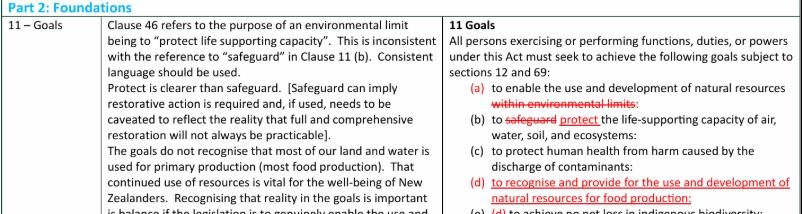
Dairy NZ suggested the following changes to part of the Goals in their submission [6]:
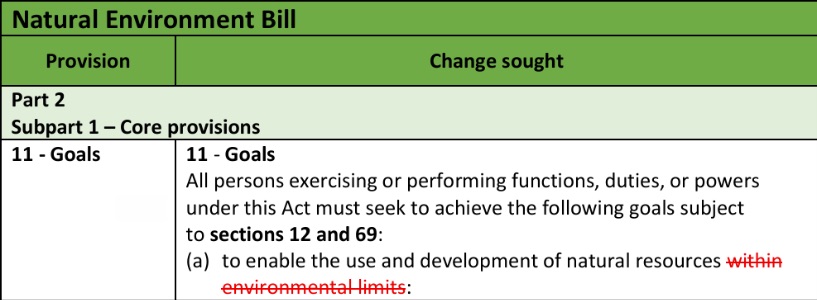
Beef + Lamb suggested similar changes to the Goals in their submission [7]:
(3) Removal of the precautionary principle
When originally proposed, the Natural Environment Bill required decision-makers to use the “precautionary principle”:
166 Precautionary principle where information uncertain or inadequate
- When deciding whether to grant or refuse an application for a natural resource permit, a permit authority must favour caution and environmental protection if the information available to determine the application is uncertain or inadequate.
- …
However, following industry lobbying, this was removed in the Select Committee and final versions of the Bill.
Advice to the Minister following the “agriculture and horticulture sector workshop” held on 18 March 2026 workshop[4], released by OIA, states that “at the workshop with agriculture representatives, [the Minister] agreed to consider the following … Add additional guardrails to clause 166 (the precautionary principle in the NEB), or remove it entirely”
The removal of the principle appears to have been pushed through, with section 166 deleted in its entirety.

(4) Climate change: Preventing decision-makers from considering the negative impacts of greenhouse gas emissions
When originally proposed, the Natural Environment Bill had no restrictions on how the impacts of greenhouse gas emissions could be considered by decision-makers. However, following industry lobbying, the Select Committee and final versions of the Bill included a new section 15A that prevents decision-makers from considering the negative impacts of greenhouse gas emissions:
15A Considering climate change effects
A person exercising or performing a function, duty, or power under this Act who is considering the effects of an activity—
- must not, despite section 15, consider any adverse effect on climate change of any greenhouse gas emissions that will or may result from or be increased by the activity, whether directly or indirectly;
…
Advice to the Minister following the workshop[5], released by OIA, notes representatives at the “agriculture and horticulture sector workshop” were “concerned, for example, that greenhouse gas emissions effects and spiritual effects could still be considered”. Officials recommended against any changes, noting that “narrowing the scope of effects that can be considered has a high risk of unintended consequences and is generally not advisable… we recommend this is left generally to local decision makers… with direction from national instruments.”
The advice also notes that the exclusion of “greenhouse gas emissions” was “suggested” by Simon Court, Parliamentary Under-Secretary for RMA Reform and ACT Party MP.
Exclusion of greenhouse gas emissions was also requested in Federated Farmers’ submission[6] on the Natural Environment Bill, for example:
Recommendation:
Federated Farmers seeks that a clause is added to the Natural Environment Bill explicitly stating that the regulation of greenhouse gas emissions is out of scope.
The Minister seems to have proceeded with Federated Farmers request, following additional discussions at the “workshop” and a suggestion to do so from Under-Sec. Simon Court. The final version of the Bill prevents decision-makers from considering the negative impacts of greenhouse gas emissions.
(5) Consenting activities “even if a limit is breached”
Advice to the Minister following the workshop[7], released by OIA, notes “the agriculture and horticulture sector wants to ensure activities can be consented even if a [environmental] limit is breached… ”.
Officials’ advised that “enabling permits to be issued that would breach environmental limits would have significant consequences for the integrity of the system.” They recommended only allowing for a permit to be granted that breaches a limit “provided it complies with an interim limit” (i.e., that improvement is being made over time).
Relatively wide scope for activities that breach environmental limits has then been provided for, to be determined by the Minister in National Direction, against the advice of officials (which was simply to clarify policy intent around limits).
(6) “Protecting ‘life-supporting capacity’ sets too high a bar to meet”
Advice to the Minister[8], released by OIA, notes that “the agricultural and horticultural raised concerns about whether protecting ‘life-supporting capacity’ sets too high a bar to meet when determining a limit” and that they “are also concerned that a hierarchy in favour of environmental protection is created by requiring a decision maker be satisfied that that [sic] the limit protects life-supporting capacity…”
It goes on to note “the sector considered this meant that setting limits to achieve ecosystem health… overrode taking into account the economic impacts and social aspirations”.
Officials suggested clarifying clauses about ecosystem health limits with a “floor” stating that “ecosystem health limits must, as a minimum, prevent significant or irreversible harm to the natural environment”. This is the approach taken for human health limits. However, this was not added into the Bill.
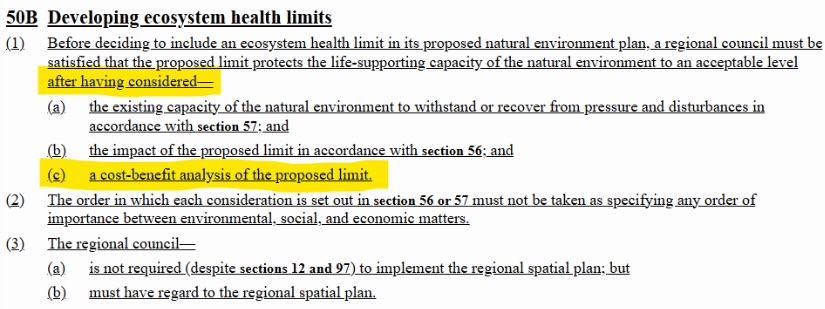
(7) Requiring cost-benefit analysis of ecosystem health limits
A briefing to the Minister [13], released by OIA, notes “Submitters, including the agriculture sector, requested the Bills make more explicit how costs and benefits are provided for when setting environmental limits.”
An example of this is in the Dairy NZ submission [14]:

Officials advised against requiring formal cost-benefit analyses in considering environmental limits, noting
“Formal CBSs are considered inappropriate for decisions related to environmental management. Whereas a CBA accounts for the benefits of development projects depreciating over time, it does not account for benefits of actions that will appreciate, such as those to achieve a limit like fencing or planting. The outcome of CBA for environmental matters is often more influenced by decisions about the technical methodology, especially the discount rate, than anything else. Furthermore, a CBA cannot fully account for the benefits of the environment protected by a limit as it is not possible to accurately monetise benefits from nature such as clean water for swimming or flood attenuation from green infrastructure such as wetlands…. Adding a requirement to undertake a CBA would add additional process cost and potentially time to limit setting and we don’t see any benefit from it over and above the comprehensive assessment of impacts already required.”
Despite this advice, cost-benefit analyses are required in the final version of the Natural Environment Bill for developing ecosystem health limits in regional plans, and when setting out methodologies for limit-setting in national direction.
(8) Guaranteeing “farmer and grower” engagement on Action Plans while avoiding “open” (i.e. public) consultation
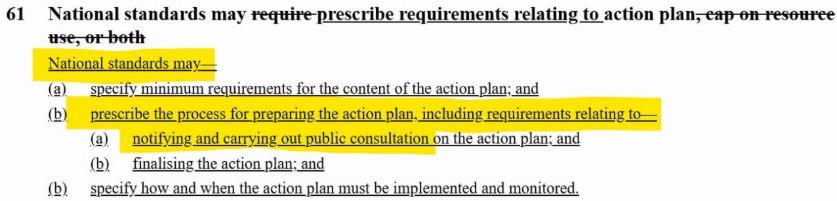
‘Action Plans’ are plans that would be written by councils to help avoid breaching environmental limits or remedy breaches of environmental limits. They could include regulatory (i.e. rules) or non-regulatory (e.g. voluntary) measures. The intention in the Bill as first read was that these plans would be developed though a normal consultation process with the community (under the Local Government Act).
However, a briefing to the Minister [15], released by OIA, notes “Agriculture and horticulture sector representatives consider that action plans should be developed collaboratively, and the process should guarantee community (particularly farmer and grower) engagement, but avoid a Local Government Act (LGA) 2002 ‘open consultation’ situation.”
Industry also seems to have pushed for the focus of action plans being non-regulatory (e.g. voluntary), rather than regulatory (e.g. rules-based) measures.
It appears the sector was successful in limiting ‘open’ consultation.
In the final version of the Bill, the process for this consultation is left to the Minister, who can prescribe a process for preparing and consulting on an action plan.
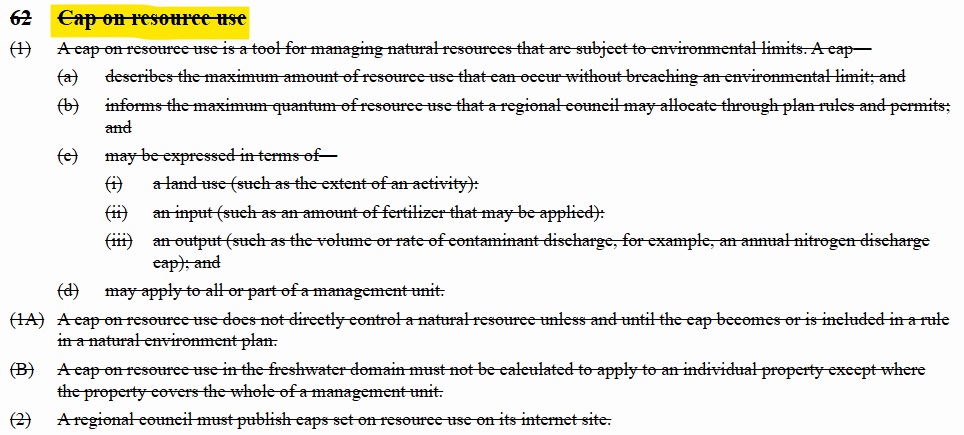
(9) Deletion of all references to “caps on resource use”
A briefing to the Minister[9], released by OIA, notes “The agriculture sector raised concerns about the role and priority of considering resource caps in the legislation. They also raised concerns about the use of resource caps, and that they should not apply at the property scale.”
A cap on resource use is a tool to help meet an environmental limit. Examples are limits on the area of land in a certain use, a limit on the amount of fertiliser that may be applied, or a limit on annual nitrogen leaching.
The briefing from officials noted “we recommend not changing this clause”.
In the final version of the Bill, all references to caps on resource use appear to be deleted.
(10) “Clarify[ing]” the role of Freshwater Farm Plans (FW-FPs)
A briefing to the Minister[10], released by OIA, notes “[The Minister] agreed to Clarify the role of FW-FPs in the new system…”.
This is mirrored by several asks related to farm plans in the document provided by the agriculture and horticulture attendees to the Minister[11] at the 18 March sector “workshop”.
Changes were announced to the farm plan system in a Beehive press release on 19 August 2026: Decisions on Freshwater Farm Plans released | Beehive.govt.nz
11-Blocked regional councils from protecting the inshore marine environment from destructive fishing activity
In a last-minute amendment paper, the Govt added section “10B Rules that control fishing” to the Bill, blocking regional councils from protecting the inshore marine environment from destructive fishing activity.
Environment NGOs call for dumping of the Government’s RMA replacement bills | EDS
Appendix 1:
Appendix 2: “agriculture and horticulture sector workshop”
Minister for RMA Reform, Chris Bishop, “ran an agriculture and horticulture sector workshop on 18 March 2026” (PQW 20230 (2026)). It is listed as “ATTEND: Natural Environment Bill Workshop” 12:30 PM – 4:30 PM in his Ministerial Diary for March.
Parliamentary Under-Secretary Simon Court also attended the workshop. It is listed as “MEET: Natural Environment Bill Workshop” in his Ministerial Diary for March.
Minister for Agriculture Todd McClay also apparently attended the workshop, however it does not appear to be recorded in his March 2026 diary release (compare PWQ 28216 (2026) to McClay’s March 2026 diary).
Attendees at the workshop were:
- Agriculture sector representatives:
- Kate Scott, CEO, Horticulture NZ;
- Emily Levenson, Environment Policy Advisor, Horticulture NZ;
- Stephen McNally, Principal Policy Advisor, Irrigation NZ;
- Paul Melville, GM Policy, Federated Farmers;
- Mark Hooper, RMA Reform spokesperson, Federated Farmers;
- David Cooper, Principal Policy Advisor, Dairy NZ;
- Roger Lincoln, GM Policy, Dairy NZ;
- Rowena Hume, GM Policy & Communications, Beef + Lamb New Zealand;
- Paul Le Miere, Head of Environment Policy, Beef + Lamb New Zealand;
- Laura Young, Manager NZ Government Affairs, Fonterra;
- Richard Allen, Sustainable Dairying Specialist, Fonterra;
- Gerard Willis, Consultant Planner, Enfocus;
- Bal Matheson, Kings Counsel, Richmond Chambers.
- Expert Advisory group representative:
- Janette Campbell, Barrister, Bankside Chambers
- Ministerial office staff:
- Joshua Smith, Senior Ministerial Advisor, Office of Hon Chris Bishop;
- Nick Wilson, Ministerial Advisor and Acting Press Secretary, Office of Simon Court MP;
- Sarah McCarthy, Private Secretary, (RMA Reform), Office of Hon Chris Bishop;
- Claire Gunning, Specialist Ministerial Advisor, Prime Minister’s Office;
- Robyn Washborne, Private Secretary, (RMA Reform), Office of Under-Secretary to the Minister Responsible for RMA Reform.
- Ministry for the Environment officials:
- Nadeine Dommisse, Deputy Secretary, Environmental Management and Adaptation;
- Hayden Johnston, General Manager, Natural Environment Policy;
- Sara Clarke, General Manager, System Enablement and Oversight;
- Bryan Smith, Chief Advisor, Environmental Management and Adaptation;
- Regan Brash, Policy Lead, Natural Environment Bill;
- Nick Martelli, Manager, Natural Resources.
- Ministry for Primary Industries officials:
- Jane Chirnside, Director;
- Sam Phillips, Manager;
- Claire McClintock, Manager.
The Minister was provided with a document of asks from the industry groups at the workshop. Following the workshop, the Minister “instructed officials to provide further advice on matters raised at the workshop.” This was provided to the Green Party via OIA (partly redacted).
[1] See PWQ 28216 (2026) “Hon Chris Bishop: Hon Todd McClay, Minister of Agriculture, and Simon Court MP, Under-Secretary to the Minister Responsible for RMA Reform, attended the workshop.” 28216 (2026). Lan Pham to the Minister responsible for RMA Reform
[2] See full list of attendees in Appendices. Also see PQW 28220 – 28220 (2026). Lan Pham to the Minister responsible for RMA Reform
[3] See PWQ 28223 (2026)
[4] 26-BRF-00578, 23 March 2026
[5] 26-BRF-00808, 7 April 2026
[6] Page 27, Federated Farmers, Submission on the NEB Bill and Planning Bill
[7] 26-BRF-00808, 7 April 2026
[8] 26-BRF-00808, 7 April 2026
[9] 26-BRF-00808, 7 April 2026
[10] 26-BRF-00808, 7 April 2026
[11] See appendices.


Greens have shared evidence that shows this ‘disgracefully dishonest’ CoC has used ‘wording’ from industry lobby groups, climate, pollution/resource use and environmental health [who will all make a huge profit] in their Natural Environment Bill [was part of the RMA] which goes to its third reading this week, despite repeated official advice and independent warnings. This CoC clearly CANNOT BE TRUSTED! Just look at the list of attendees at this Workshop 18/3/26 run by Bishop – attended by McLay! This CoC is the most deceitful bunch this country has EVER had at the helm! They should hang their heads in shame, but they won’t because they believe they are above all of us, above the law, and they have no conscience or decency plus receive huge “donations”! To have to deceive your people to get your way shows very self-entitled, smug and corrupt politicians. Marama Davidson says, “Aotearoa has one chance, on November the 7th, to stop these dystopian laws from becoming reality.” Once in, could the Left rescind this Bill along with all the other insidious, contentious ones? Kiwis, really THINK before you place your vote – OUR future and lives may depend on it!
This is just another immoral move from this govt. This should be stopped until after the election. We have come to accept bullying immorality and short-term thinking from this govt. so that’s what we’ve got.
Labour needs to immediately and loudly support the Greens on this.